Your supplier in Shenzhen sends a bill of lading number. You paste it into the shipping line’s tracking page and get “no results”. Meanwhile your customer in Pune wants to know when the container will reach the CFS, and the only person who can tell you is an agent who stopped replying on Friday.
Container tracking is supposed to end that kind of chase. It often doesn’t, because the number you’re holding isn’t always the number the system wants. This guide explains what container tracking actually shows, which reference to use, how tracking works in India specifically, and what to look for in container tracking software if you handle more than a few shipments a month.
What container tracking actually tells you
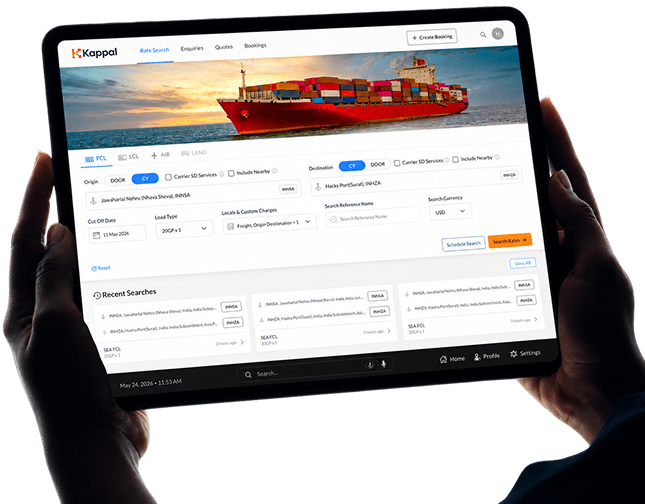
Tracking is a timeline of events attached to a container: gate-in at the origin terminal, loading, vessel departure, transshipment, arrival, discharge, customs release and gate-out. On the Indian side it also includes movement to an ICD or CFS. Good tracking adds an ETA, and the detail that costs money when ignored: free days before detention and demurrage start. Kappal’s track and trace view shows cargo status, ETAs, container details, charges, documents, dimensions and free days in real time.
That last point is why tracking is more than curiosity. A missed ETA change can mean an unplanned trucking slot, a customer who wasn’t warned, or storage days nobody budgeted for.
The three numbers you can track with
Container number. Every container carries an ISO 6346 code made up of an owner prefix, an equipment category letter, a six-digit serial number and a check digit. That is 11 characters in total, and the category letter is U for standard freight containers, J for detachable equipment and Z for trailers and chassis. Take CSQU3054383. CSQ is the owner, U the category, 305438 the serial and 3 the check digit. The check digit is computed from the other ten characters, which is what lets a system catch a mistyped number. If a tracker rejects yours, check the digit before blaming the carrier.
Bill of lading (BL) number. For ocean freight tracking, the master BL is usually the best key, and most shipping lines build their master BL numbers from a four-letter SCAC code plus digits; a number that doesn’t follow that pattern may be a house BL. This is where most bill of lading tracking attempts fail. When you ship through a forwarder, especially LCL or consolidated cargo, you often hold a house BL. Carrier tracking sites only know master references, so a house number may show nothing. Ask your forwarder for the master BL, or track by container number.
Booking number. Useful before the BL is issued, and a handy fallback when the BL doesn’t resolve.
How to track a container by container number
- Get the full 11-character number from the BL, packing list or delivery order. Watch for O/0 and I/1 mix-ups.
- Confirm the carrier. The prefix is a clue, but leased containers can carry a lessor’s prefix, so check the BL.
- Enter the number on the carrier’s tracking page or a multi-carrier tool.
- Read the events in order. Note the latest status, vessel, voyage and ETA, not just the headline.
- Check the inland leg. For imports, has the box left the port, reached the CFS or ICD, and when do free days end?
- Recheck at fixed points or set alerts, because ETAs shift.
Why your ETA keeps changing
An ETA is a forecast, not a promise. The usual culprits are a missed transshipment connection, a vessel waiting for a berth, cargo rolled to the next sailing because the ship was full, or a schedule change by the line. Picture an importer in Ludhiana waiting on a box from Jebel Ali. The vessel is on time, but the transshipment connection slips by four days, and the first anyone hears of it is when the ICD calls. Tracking that records each event, and shows when the ETA moved and by how much, gives you time to re-plan. Pair it with a vessel schedule search and you can also see the next realistic sailing for a rolled container.
Container tracking in India: what’s different
India runs a national container tracking platform. The Logistics Data Bank (LDB), operated by NICDC Logistics Data Services, uses RFID, IoT and cloud technology to follow containers across ports, rail, industrial zones, borders and highways. It tracked its 10 crore-th EXIM container in August 2026, reports visibility of 100% of India’s EXIM container movement across 19 ports and 32 container terminals, and logs over 1.5 crore searches a month through its single-window website. LDB 2.0, launched in September 2025, added high-seas tracking of export containers and multimodal visibility.
That covers the domestic leg well. But LDB follows containers; it doesn’t know your booking, your customer or the delivery date you promised. And it’s one source among several. You still need the ocean carrier’s event data for what happens between loading and arrival, and forwarders often end up stitching the two together by hand.
The export side shows why this matters. The National Time Release Study 2025 recorded average regulatory clearance of about 29.6 hours for exports at seaports, followed by nearly 158 hours of post-clearance logistics. That is more than six days in which a shipment can sit waiting, and where visibility on terminal and gate movements saves you phone calls.
Why carrier-by-carrier tracking breaks down for forwarders
With ten shipments a month, basic shipment tracking on each carrier’s site is fine. At fifty, it isn’t. The usual failure points look like this:
- A browser tab for every shipping line, each with its own layout
- House BL numbers that return nothing
- ETA changes that arrive without any alert
- Updates relayed by email or phone instead of one shared view
- Cargo booked through other agents that you can’t see at all
A word on “real-time shipment tracking”. In practice it means near-real-time: carrier and terminal feeds update when events are reported, and some tools add vessel position from AIS data. Most shipping containers have no built-in GPS, so anyone promising a live dot on a map for every box is overselling.
What to look for in container tracking software
Whatever you choose, test it against this list:
- Carrier coverage, including smaller carriers and lesser-known lanes
- Tracking by container, master BL and booking number
- ETAs and event history, not just a pin on a map
- Free-day visibility and alerts, so detention and demurrage don’t surprise you
- Shareable tracking links for customers
- Cargo tracking for shipments booked elsewhere, not only your own bookings
- The Indian inland leg, from port to CFS or ICD
Kappal’s Track and Trace lets you search shipments across ports worldwide, whether they’re booked through Kappal, shipping lines or external logistics partners. Teams can also share live container tracking links directly with customers, which cuts down the “any update?” calls. For forwarders weighing broader shipment management software, tracking is often the easiest module to start with. If you quote air cargo too, our guide to air freight rates from India explains chargeable weight and how to compare quotes.
Use tracking data to protect your margin
Three habits make tracking earn its keep. Check the latest ETA before you book the truck, not after. Watch free days from the day of discharge so you can move the box before charges start. And send customers an update before they ask for one. A customer who hears from you first stops chasing.
Conclusion
Container tracking works when you hold the right reference and your data comes from more than one place. Know whether you have a container number, a master BL or a house BL; use LDB for the domestic leg; and give your team one view instead of a dozen tabs. The shipments don’t get faster, but you stop learning about delays from your customers.
If you want to see how that looks with live data, you can book a demo of Kappal’s Track and Trace.
FAQs
How do I track a container by container number?
Enter the full 11-character container number, such as four letters followed by seven digits, on the shipping line’s tracking page or a multi-carrier tracker. Confirm the carrier if asked. You’ll see events such as loading, departure, discharge and gate-out, along with the vessel, voyage and ETA.
Can I track a shipment with a house bill of lading?
Usually not on a carrier’s website. Carriers issue master BLs, while forwarders issue house BLs that carrier systems don’t recognise. Ask your forwarder for the master BL or container number, or use a tracking platform your forwarder shares with you.
How accurate is real-time container tracking
It depends on the data source. Event-based tracking is only as current as the carrier and terminal reports behind it, and ETAs can change when vessels reschedule or ports are congested. Treat the ETA as a moving estimate and recheck it before committing trucks or customers.
What is the Logistics Data Bank and how do I use it?
The Logistics Data Bank (LDB) is India’s RFID-based platform for tracking EXIM containers across ports, terminals, CFSs, ICDs, rail and toll plazas. Logistics stakeholders can search by container number through its single-window website.
Why does my container tracking show “no data”?
Common causes include a typo (the check digit won’t validate), a house BL used instead of a master BL, the wrong carrier selected, or a container that hasn’t yet been gated in. Recheck the number against your documents and try the container number instead of the BL.
Is container tracking software worth it for smaller forwarders?
If you’re juggling more than a handful of shipments across several carriers, yes. A single view with ETAs, saves time that would otherwise go to portals, calls and emails. Test any tool on a few live shipments, including one booked elsewhere, before committing. Kappal’s Track and Trace is built for exactly this workflow.