
Picture a garment exporter in Tiruppur asking two forwarders to quote air freight to Frankfurt. One comes back at ₹250 per kg, the other at ₹275. The cheaper quote wins the order. Then the invoice arrives with fuel and security surcharges, handling and an airway bill fee that the second forwarder had already built into the rate. Same cargo, same flight, bigger bill.
That gap between the number on the quote and the number on the invoice is the real problem with air freight rates from India. Rates change daily, quotes are put together differently, and the weight you’re billed on often isn’t the weight on the scale. This guide explains how air freight charges are built, how to work out chargeable weight yourself, and how to compare air freight quotes on a like-for-like basis.
Why air freight quotes from India rarely match
Ask three forwarders for air cargo rates from India and you’ll usually get three differently shaped answers. One quotes airport-to-airport, another door-to-door. One includes surcharges, another lists them separately. One puts you on a direct flight; another routes via a Gulf hub because it shaves a little off the per-kg rate. With no common basis, trying to compare air freight rates turns into guesswork.
For forwarders, the pain is the process as much as the price. The client asks for a rate, you call or email several airlines and consolidators, the replies land at different times, and your answer goes back hours later. By then the airline may have revised its rate or the space may be gone. Whoever replies first with a number they can actually honour usually wins the shipment.
What goes into air freight charges
The airline’s base rate per kg is only the first line of the bill. Charges differ by airline, airport and forwarder, but a typical air freight invoice from India is built from these pieces:
- Base freight: the rate per chargeable kg, usually with weight breaks, so the per-kg rate drops as your chargeable weight crosses certain thresholds. Very small consignments attract a minimum charge.
- Fuel and security surcharges: often charged per kg, sometimes folded into the rate.
- Airway bill (AWB) fee: a per-shipment charge that can appear for both the master and house AWB.
- Terminal handling and screening at the origin airport.
- Export clearance and documentation, plus trucking to the airport if you’ve asked for door-to-door.
- Destination charges, duties and taxes, which many quotes leave out entirely.
You don’t need to memorise the list. You need to know which of these lines your quote includes and which it quietly skips.
Chargeable weight: the number that decides your bill
Airlines sell space, not just weight, so they bill on chargeable weight: the greater of actual gross weight and volumetric weight. The IATA standard divides the cubic centimetres of a package by 6,000, which equates to a density threshold of 167 kg per cubic metre. Express and courier operators such as DHL, UPS and FedEx commonly use a tighter divisor of 5,000.
Volumetric weight (kg) = length × width × height (cm) ÷ 6,000
Here is a worked example. Say you’re shipping 12 cartons of garments, each 60 × 50 × 40 cm and weighing 14 kg.
- Each carton: 120,000 cm³ ÷ 6,000 = 20 kg volumetric
- Total volumetric weight: 240 kg. Total actual weight: 168 kg.
- Chargeable weight: 240 kg
At an illustrative ₹250 per kg (a placeholder, not a market rate), that’s ₹60,000 for a consignment that weighs 168 kg. Now suppose the same goods can be repacked into 55 × 45 × 35 cm cartons. Each works out to 14.4 kg volumetric, and the total of 173.25 kg is typically rounded up to the next half-kilo, so 173.5 kg. The bill drops to ₹43,375, a saving of ₹16,625 or about 28%, from cardboard alone.
Cargo denser than 167 kg per cubic metre, such as machinery parts and metal components, is charged on actual weight. Lighter, bulkier goods like garments, plastic parts, handicrafts from Moradabad or packaging material usually get billed on volume. Check your cartons before you check the rate.
Why air cargo rates from India keep moving
Air freight rates follow capacity, season and fuel, and all three are shifting right now. Indian airports handled 3.7 million tonnes of cargo in FY2024-25, a 10% rise on the previous year. In June 2026 they handled a record 364,289 tonnes, up 16% year on year, with international cargo making up nearly 64% of the total. Traffic is concentrated, too: Delhi accounts for nearly 30% of the country’s air cargo, so capacity out of the big gateways is where rates feel pressure first.
Seasonality matters. October to December is the busy stretch. In late 2023, Indian forwarders told The Loadstar that rates to North America were up 8–10% and to Europe about 10% against the June–August lean period, driven by festive and e-commerce volumes. On fuel, oil marketing companies raised ATF prices on 1 October 2026 to around ₹137 a litre from ₹121, according to Business Today, and fuel is one of the costs that reaches shippers as a surcharge.
So treat an air rate as a snapshot, not a tariff. A rate quoted on Monday is a statement about Monday’s capacity.
How to compare air freight quotes properly
Line every freight quote up on the same basis before you look at the per-kg figure.
| What to check | Why it matters |
| Chargeable weight and divisor used | A 5,000 divisor produces more chargeable weight than 6,000 |
| Airport-to-airport or door-to-door | Pickup and clearance can add a lot |
| Surcharges included or extra | Fuel, security, AWB and handling change the real rate |
| Direct or connecting routing | Cheaper connections add handling and missed-connection risk |
| Space confirmed or on request | A low rate without space doesn’t protect your delivery date |
| Validity | Rates can change before you book |
| Exclusions | Destination charges, duties, insurance |
Then convert each quote into a total cost per chargeable kg. The forwarder at ₹275 who includes everything is often cheaper than the ₹250 quote that doesn’t.
The last step is freight rate benchmarking: check today’s quote against what the same lane cost recently, not only against the other quotes in your inbox. If you only compare against the quotes on your screen, you can’t tell whether all of them are high.
Practical ways to bring air cargo charges down
- Fix the packaging first. As the example showed, carton size can move the bill more than haggling over the rate.
- Compare departure airports on total cost. The cheapest airport on paper may add trucking, and a connecting route may add handling.
- Book outside peak weeks where the delivery date allows. Q4 capacity is tight.
- Split urgent from non-urgent. Fly what’s needed now and send the balance by sea.
- Keep paperwork clean. The National Time Release Study 2025 found export regulatory clearance at air cargo complexes was fastest, at under four hours, so lost time is more likely to come from missed cut-offs and incomplete documents than from clearance itself.
Air or sea: when the premium pays for itself
Air freight is rarely the cheapest option per kg, and that isn’t the real question. The question is whether the extra freight cost is smaller than the cost of waiting: a stopped production line, a missed retail window, a penalty clause. For electronics, pharma, samples and spares, the answer is usually yes. For heavy, planned, repeat cargo, ocean freight is almost always cheaper, and our guide to the lowest freight shipping rates covers that side. Once a sea shipment is booked, our guide to container tracking in India shows how to follow it.
Where software helps
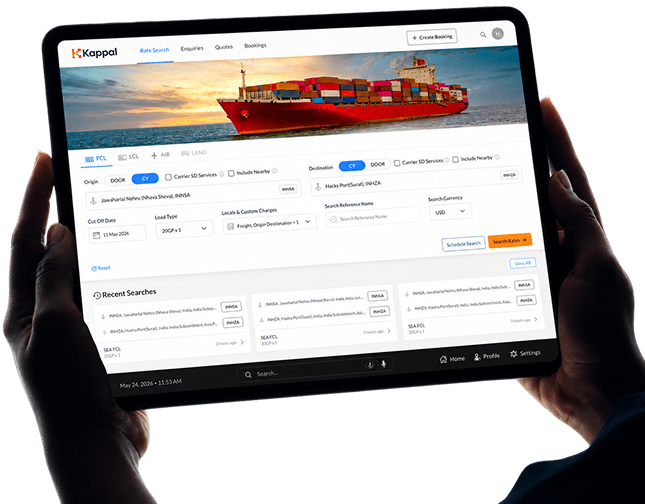
The manual loop of calling airlines, pasting numbers into a sheet and re-checking validity is exactly what a digital freight platform is meant to remove. Kappal’s air freight search is connected to 90+ airlines and consolidators through API integrations. You enter the origin, destination, weight and dimensions, compare rates side by side and send a quote from the same screen. It won’t decide your packaging or routing for you, but it takes the rate-chasing out of the first hour. For more on where the technology is heading, see our piece on integrating technology into air freight services.
Conclusion
Air freight charges from India are easy to understand once you split them into pieces. Work out chargeable weight yourself, ask what each quote includes, compare on total cost per chargeable kg, and treat every rate as time-limited. Do that and the quote and the invoice stop being two different numbers.
If you’d rather see live air freight rates and quote clients in minutes than assemble them by phone, you can book a demo of Kappal’s air freight search.
FAQs
How are air freight charges calculated from India?
Airlines bill on chargeable weight, the higher of actual and volumetric weight, multiplied by the rate per kg. Fuel and security surcharges, airway bill fees, terminal handling, export clearance and any pickup are added on top. Destination charges and duties are usually separate.
What is the volumetric weight formula for air cargo?
Multiply length, width and height in centimetres, then divide by 6,000 for standard IATA air freight. One cubic metre therefore equals about 167 kg. Courier and express services commonly divide by 5,000, so the same carton can attract more chargeable weight with them.
Why do air freight quotes differ between forwarders?
Quotes are rarely built the same way. They can differ in scope (airport-to-airport or door-to-door), including surcharges, airline and routing, space confirmation, validity and the margin the forwarder adds. Compare total cost per chargeable kg rather than the headline rate.
How can I compare air freight rates online?
Use a platform that pulls live rates from several airlines and consolidators, then check each result on the same basis: chargeable weight, surcharges, routing and validity. Kappal’s air freight search shows rates side by side from airlines and consolidators connected through APIs.
Do air cargo rates rise in the festive season?
They often do. Forwarders reported increases on India–North America and India–Europe lanes during the 2023 festive build-up, and October to December is typically the tightest part of the year for capacity. Moves differ by lane and week, so check live rates rather than relying on last year’s pattern.
Is air freight worth the extra cost compared with sea freight?
When the cost of delay is higher than the freight premium, yes. Production-critical spares, samples, pharma and high-value goods usually qualify. Heavy, predictable, low-value cargo is better planned by sea, and many shippers split a consignment: the urgent quantity by air, the balance by ocean.