Picture a forwarder sending a quote for a 40-foot container: $2,000 to the destination port. Three weeks later the invoice reads closer to $2,750. Nothing was hidden, exactly. The emergency surcharge, the peak season charge and the local charges were sitting on separate lines, and nobody added them up at the time of booking.
If you’ve been asking what container shipping cost India exporters and importers face right now, the honest answer is that the headline rate is only one part of it, and in late 2026 the other parts are moving more than usual. This guide shows what goes into container freight charges, which surcharges are changing this month, and how to build your own container shipping estimate before you ask for a quote.
Why container rates are only part of the story
The global benchmark gives a sense of the mood. Drewry’s World Container Index fell 2% to $4,305 per 40ft container on 12 November, and carriers have announced higher FAK and peak season surcharges on Asia–Europe routes for the second half of the month. The index is measured on routes from Shanghai, not India, but it shows a soft market where container rates drift down while surcharges push the other way.
On Indian lanes, disruption around the Strait of Hormuz has kept emergency charges in play. Maersk introduced a global emergency bunker surcharge in March, noting that about 20% of global fuel moves through the strait. Its India and Middle East news page lists announcements on six different days between 3 and 11 November, covering peak season, emergency contingency and Hormuz-related items. Base rates and surcharges move on different clocks, and a quote that doesn’t show both is a quote you can’t trust.
Container shipping cost India: what goes into the invoice
Sea freight pricing is built in layers, and shipping freight charges don’t stop at the ocean leg. A typical container freight invoice from an Indian port includes:
- Basic ocean freight: the carrier’s base rate per container on the lane. Ship freight charges for a full container are billed per box; LCL is billed per cubic metre.
- Fuel-related surcharges: bunker or emergency bunker charges, sometimes folded into the rate.
- Emergency contingency surcharge (ECS): a lane-specific charge carriers add for disruption and reroutes, reviewed regularly.
- Peak season surcharge (PSS): seasonal, announced with an effective date.
- Origin local charges: terminal handling, documentation, seal and equipment-related fees.
- Inland haulage and CFS charges, if the cargo moves to or from an inland depot.
- Destination charges: terminal handling, delivery order and clearance costs at the other end, plus duty, which isn’t freight at all.
- Detention and demurrage exposure, which only shows up if free days run out.
Other international shipping charges, such as insurance and customs duty, sit outside the freight invoice but belong in your landed cost. Many of the extras don’t appear on the first quote, which is why the quote and the invoice drift apart.
Surcharges changing right now
These are examples of live changes from carrier announcements. They are carrier- and lane-specific, so check whether they touch your cargo.
| Change | Scope | Effective |
| Maersk ECS rises from $500 to $1,500 per container (20ft and 40ft dry) | India, Bangladesh, Sri Lanka to South Africa and Indian Ocean Islands | 1 November 2026 |
| Maersk revised PSS of $3,850–4,200 per container depending on origin; not applied to Maersk Spot bookings | Indian Subcontinent to US and Canada East Coast and Gulf (excluding Houston) | 8 November 2026 |
| Maersk heavy-load surcharge set to zero for 20ft containers above 22 tonnes VGM | Nhava Sheva, Mundra, Pipavav and Hazira to North Europe and Mediterranean, contract bookings | 7 November 2026 |
| Hapag-Lloyd Container Positioning Origin charge of ₹1,250 per 20ft and ₹750 per 40ft | Exports from Nhava Sheva, Mundra and Kandla | 10 December 2026 |
The ECS increase takes effect from the price calculation date of 1 November 2026. The revised North America PSS applies from 8 November and doesn’t cover Maersk Spot bookings. The heavy-load surcharge is withdrawn for eligible 20ft containers from 7 November. Hapag-Lloyd’s positioning charge applies to all exports from Nhava Sheva, Mundra and Kandla from 10 December. One charge rises, one is revised, one disappears and one is brand new. You can’t estimate this month’s cost from last month’s invoice.
The Gulf trade shows how far container shipping prices can swing. The Loadstar reported in October that spot rates from Nhava Sheva to Khor Fakkan had reached $6,000 to $7,000 per 40ft container.
How to estimate container shipping cost, step by step
Use this formula to estimate shipping cost per container before you ask anyone for a quote:
Total cost per container = ocean freight + fuel and emergency surcharges + PSS + origin local charges + inland/CFS + destination charges + a buffer for detention
Here is a worked container shipping estimate for one 40ft container. The numbers are placeholders to show the method, not market rates.
| Line | Illustrative amount |
| Ocean freight | $2,000 |
| Emergency contingency surcharge | $300 |
| Peak season surcharge | $200 |
| Origin THC, documentation, seal | $250 |
| Total before inland and destination | $2,750 |
The headline $2,000 is about 73% of the total, and the extras add 37.5% on top. Add inland haulage, destination charges and a detention buffer, and the gap between “what the quote said” and “what the box cost” is wider still.
Do this for every quote you receive, then compare the totals, not the headlines. A sea freight estimate from your forwarder should be able to fill every line of this table.
Why two quotes for the same container can differ
Same box, same port pair, different totals. The usual reasons:
- All-in versus base plus extras. One forwarder bundles surcharges into the rate; another lists them below the line.
- Spot vs contract rates. The Maersk PSS above doesn’t apply to Maersk Spot bookings, which shows that the booking type can change which charges you pay.
- Calculation dates. Carriers apply surcharges by price calculation date, which isn’t always the booking date or the sailing date. Ask which date your quote uses.
- Equipment and weight. The heavy-load surcharge change above only affects 20ft containers over 22 tonnes VGM.
- Routing. Direct and transshipment services price differently and carry different risk.
A good quote states its validity, its calculation date and what’s excluded. If it doesn’t, ask.
A quick example: the cheaper-looking quote that costs more
Say two forwarders quote the same 40ft container on the same lane. The figures below are placeholders to show the pattern.
| Quote A | Quote B | |
| Headline rate | $2,600 all-in | $2,000 plus surcharges |
| Surcharges and local charges | Included | $750 extra |
| Real total | $2,600 | $2,750 |
Quote A looks $600 dearer and ends up $150 cheaper. This is the same trap as the per-kg air freight quote, where the lower headline hides the extras. If you quote air cargo too, our guide to air freight rates from India shows the same like-for-like method.
Five questions settle most of it. Before you accept any quote, ask:
- Is this rate all-in, and what is excluded?
- Which surcharges apply, and from what date?
- Is it a spot or a contract rate, and how long is it valid?
- How many free days do I get at origin and destination?
- Is the routing direct or transshipment, and on which sailing?
Booking in November and December: what to check
- Ask for the surcharge list, not just the rate. ECS, PSS and fuel charges should each appear with an effective date.
- Check your sailing against known changes. If you export via Nhava Sheva, Mundra or Kandla on Hapag-Lloyd, the 10 December positioning charge applies to export shipments from that date.
- Confirm the vessel schedule with a vessel schedule search before you commit to a cut-off. Rolled cargo and blank sailings change both cost and timing.
- Benchmark against recent lane history, not only against the other quotes on your screen. Our guide to the lowest freight shipping rates has more on saving money without cutting corners.
- Note free days. Detention is the cost that arrives after the invoice, and container tracking helps you see it coming.
- Remember insurance. Marine cargo insurance is part of landed cost too.
Where software helps
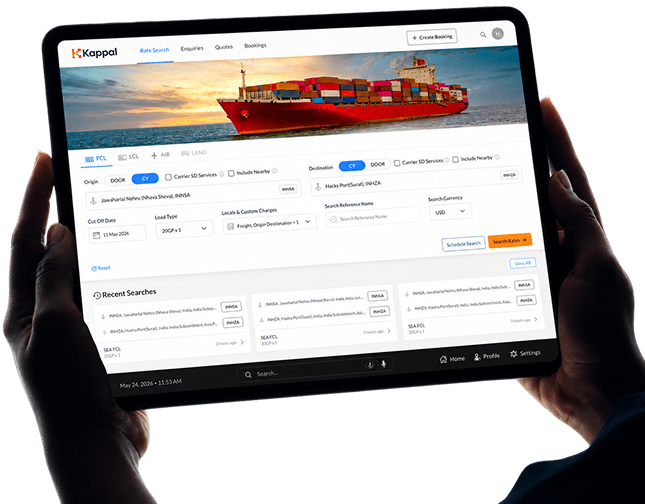
Collecting container rates from several carriers by email is where totals go wrong: each reply arrives in a different format, with different surcharges, at a different time. Kappal’s ocean freight search gives access to real-time pricing from 25+ shipping lines and NVOCCs, and its plans include instant price benchmarking and transit-time comparison. You still need to read the surcharge lines, but you read them side by side instead of across a dozen inboxes.
Conclusion
Container shipping cost from India isn’t one number. It’s a base rate, a handful of surcharges that change on their own schedules, and local charges at both ends. Estimate shipping cost yourself, compare quotes on the same date basis, and check carrier advisories before you book. Do that and the invoice stops surprising you.
If you’d like to compare live container rates and see the full picture in one view, you can book a demo of Kappal’s ocean freight search.
FAQs
How much is the container shipping cost India exporters should budget?
It depends on the lane, container type, season and carrier, so there is no single figure. The headline ocean rate is only part of it; add surcharges, local charges and inland costs. Global indices like Drewry’s WCI track Shanghai-origin routes, so use them to gauge where container rates are heading, not as a quote.
What charges are included in container freight charges?
Typically basic ocean freight, fuel and emergency surcharges, peak season surcharge, origin local charges (terminal handling, documentation, seal) and sometimes inland haulage. These shipping freight charges are billed per container, so ship freight charges differ between a 20ft and a 40ft box. Destination charges and duty are often separate. Always ask what a quote excludes.
How can I estimate shipping cost for a container before getting a quote?
Add up ocean freight, surcharges, origin local charges, inland costs, destination charges and a detention buffer. A container shipping estimate built this way gives you a benchmark; verify each line against current carrier advisories. A good forwarder’s sea freight estimate should list every one of them.
Why do container shipping prices change so often?
Base rates follow supply and demand, while surcharges follow fuel prices, disruption and season, each on its own schedule. In 2026, Hormuz-related disruption has added emergency charges that carriers review regularly, so sea freight pricing can shift between booking and sailing.
What is the difference between spot vs contract rates?
Spot rates are priced for a specific booking at today’s market level. Contract rates are agreed for a period or volume. Carrier surcharges don’t always apply the same way to both, as the Maersk PSS exclusion for spot bookings shows.
What is a peak season surcharge?
A temporary charge carriers add when demand is high or capacity is tight. It is announced per trade lane with an effective date and can be revised or withdrawn, so check the current notice before you budget for international shipping charges.