It’s early December. Your team is closing the year with five browser tabs per shipment, a rate sheet last updated in September and a WhatsApp group that doubles as the status report. January’s volumes are about to land on top of all that.
This is usually the moment forwarders start looking at freight forwarding software India teams can actually adopt, and it’s also where the search gets confusing. Software for freight forwarders covers several very different jobs, vendors describe themselves in overlapping words, and a tool that fixes slow quoting won’t fix messy invoicing. This guide breaks the category into layers, lists the questions that separate a good fit from an expensive mistake, and shows how to test freight forwarder software in two weeks without disrupting live work.
Freight forwarding software India: what it actually covers
Think of three layers. Most products are strong in one and thin in the others.
1. The back office. Job costing, invoicing, accounting and shipment documents. Full forwarding systems in this layer often bundle sailing schedules, rate search, eBookings and configurable workflow templates too, and they take real time to set up.
2. The commercial layer. Rate search, quoting and benchmarking. This is where a digital freight platform earns its keep. A digital freight forwarding platform replaces the loop of phoning airlines, emailing shipping lines and pasting numbers into a spreadsheet, so you can compare freight rates in one place and run a proper freight rate comparison before you quote.
3. The visibility layer. Booking status, container and air tracking, schedules, alerts and customer-facing updates. This is shipment management software and freight operations software in the plain sense: one place to see where things are and what happens next.
You rarely need to replace everything at once. The useful question isn’t “which software is best?” but “which layer is costing us money right now?”
Signs your current setup is costing you
- Replies go out hours late. A client requests a quote, you contact several shipping lines and NVOCCs, responses arrive at different times, and you reply hours later. By then the client may have moved on.
- Quotes go stale. Carriers change charges constantly. Maersk’s India and Middle East news page lists announcements on six different days between 3 and 11 November, covering peak season, emergency contingency and Hormuz-related items.
- Status calls eat the day. Customers ask where the container is, and the answer lives in someone’s inbox.
- You can’t benchmark. Without recent lane history, you can’t tell whether a quote is good or merely the first one that arrived.
- Knowledge sits in people’s heads. When one coordinator is on leave, nobody else can answer for their customers.
If three of these sound familiar, the problem is processed before it is people, and software is a reasonable fix.
Why now: volumes, volatility and better data
Cargo is growing and the market is noisy at the same time. Indian airports handled a record 364,289 tonnes of air cargo in June 2026, up 16% year on year. Ocean surcharges are being revised in the same weeks that customers ask for firm prices.
India’s digital logistics plumbing has also matured. The Logistics Data Bank reports RFID-based visibility of 100% of India’s EXIM container movement. The Unified Logistics Interface Platform is a digital gateway that gives industry players API access to logistics datasets from government systems. For forwarders, that means more data is available to plug into, provided your software can use it.
How to choose freight forwarding software: eight questions to ask
- What does rate coverage include? Which shipping lines, NVOCCs and airlines, and which modes: ocean, air, LCL, land?
- Are rates live or uploaded? Live API rates differ from a sheet someone updates on Mondays.
- How fast can you send a quote? Count the clicks from search to a quote your client can accept.
- Does it support freight rate benchmarking? Historical comparison turns a quote into a decision.
- Can you search schedules ahead? Sailing options should sit next to rates, not in another tab.
- How does tracking work? Ask what “real-time shipment tracking” means in practice: carrier and terminal event feeds, not a live GPS dot on every box. Check it works by container, master BL and booking number, covers cargo booked elsewhere, and handles house BLs. Our freight glossary explains the terms.
- Does it fit India? Indian ports, ICDs and CFSs, INR workflows and support in your time zone.
- How does it fit your other tools? Check exports, integrations, onboarding time and how pricing scales with users.
ERP vs rate platform: which do you need?
| Your biggest pain | Look first at |
| Job costing, invoicing, documents | A back-office forwarding system |
| Slow quotes, scattered rates | A rate search and quoting platform |
| “Where’s my cargo?” calls | A tracking and visibility tool |
| All of the above | Start with the layer costing you most, then integrate |
The common mistake is buying a heavy system to fix a quoting problem. It works the other way round, too: a rate tool won’t produce your invoices. Be clear about the job.
How to run a two-week pilot
- Pick ten recent quotes and re-run them in the tool. Record the time each takes.
- Compare totals, not just headline rates, against what you actually quoted.
- Track five live shipments, including one booked through another agent and one on a house BL.
- Test the customer view: can you share a live tracking link?
- Ask the team what saved time and what slowed them down.
- Check the exit: can you export your data?
If a vendor can’t support a short, real-data pilot, treat that as information.
Measure three things so the decision isn’t a feeling: the time it takes to send a quote, the gap between your quoted total and the tool’s total, and the number of “where is my cargo?” messages your team gets each week. If all three improve, you have a case. If none do, you’ve saved yourself a year of licence fees.
What a better Monday looks like
Imagine a Chennai forwarder who receives two requests before 10 a.m.: a 40ft container to Hamburg and 300 kg of samples by air to Frankfurt. With rate search and quoting in one place, the coordinator compares ocean options and airline rates side by side, picks a sailing, and sends both quotes before the client’s team has finished its first meeting. Once the container is booked, a tracking link goes to the customer instead of a Thursday phone call asking for an update. Nothing heroic happened. There were simply fewer manual steps between the enquiry and the answer.
Common mistakes when buying freight forwarder software
- Buying for features you won’t use in year one. A long feature list is not a workflow.
- Trusting the demo instead of a pilot. Demos use clean data; your shipments don’t.
- Ignoring house BLs and cargo booked elsewhere. These are exactly where tracking tools fall short.
- Skipping change management. Name an owner, set a go-live date and retire the old spreadsheet, or two systems will run in parallel forever.
- Comparing monthly fees only. Count users, modes, support and add-ons before you call one tool cheaper.
Where Kappal fits
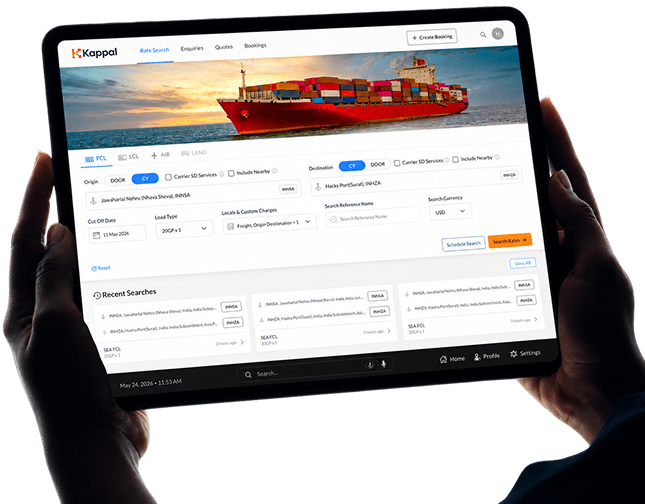
Kappal is a digital freight platform India forwarders can trial, built around the commercial and visibility layers. Its ocean freight search gives access to pricing from 25+ shipping lines and NVOCCs, and its air freight search is connected to 90+ airlines and consolidators through API integrations. The pricing page lists multi-modal rate search across ocean, air, LCL and land, with unlimited rate and schedule searches, instant price benchmarking, transit-time comparison and visibility from booking to delivery. Vessel schedule search and track and trace sit in the same workflow, which you can see on the workflow page.
Be clear about what it isn’t. Kappal describes its air product as a purpose-built rate search and quoting platform, not reporting or analytics software, and it connects with your existing workflows and tools. Keep your accounting and invoicing system; use Kappal to cut the time from enquiry to quote and from booking to delivery. The platform speaks directly to MSMEs held back by scattered rates and fragmented tracking, which is who it’s built for.
Conclusion
The right freight forwarding software India forwarders choose is the one that removes the most expensive bottleneck, not the one with the longest feature list. Work out which layer hurts most, ask the eight questions above, and test with your own shipments for two weeks. If the numbers hold up, you’ll head into 2027 with fewer tabs, faster quotes and customers who stop asking for updates.
If you’d like to try that with live data, you can book a demo of Kappal. And if container costs are on your list too, our guide to container shipping cost from India covers the estimate side.
FAQs
What is freight forwarding software?
It is software that helps forwarders handle some or all of the jobs: finding rates, quoting, booking, tracking, documentation and billing. Products range from full back-office systems to focused rate search and tracking tools, which is why software for freight forwarders is a broad label.
How do I choose freight forwarding software for a small team?
Usually not on a carrier’s website. Carriers issue master BLs, while forwarders issue house BLs that carrier systems don’t recognise. Ask your forwarder for the master BL or container number, or use a tracking platform your forwarder shares with you.
ERP vs rate platform: do I need both?
It depends on your bottleneck. If your pain is invoicing and job costing, look at a back-office system. If it’s slow quotes and scattered rates, a rate search and quoting platform will help faster. Many forwarders end up using both.
How much does freight forwarding software cost in India?
Freight forwarding software India pricing varies by product, number of users and features. Compare total cost, not just the monthly fee: users, modes covered, support and add-ons. Kappal lists its plans on its pricing page, and enterprise pricing is available on request.
How long does implementation take?
Full back-office systems typically take longer to configure than focused freight operations software or a digital freight forwarding platform. Kappal says its platform is built for immediate use, so teams can start managing shipments without long onboarding cycles or system overhauls.
Can small forwarders and MSMEs use shipment management software?
Yes. Smaller teams often gain the most from faster quoting, freight rate benchmarking and shared tracking, because each coordinator handles more shipments. Look for plans that don’t require a long contract or a large upfront setup, and check data ownership, access controls and export options before you migrate live work.